




What is teeth whitening and what does the procedure involve?

Teeth whitening is a professional cosmetic dentistry procedure aimed at lightening the natural colour of your tooth enamel. The process involves the application of controlled active substances, most commonly hydrogen peroxide or carbamide peroxide, which penetrate the tooth structure and chemically break down the pigment compounds responsible for discolouration. The result is a visibly brighter, more aesthetic smile, achieved in a safe and controlled manner.
How exactly does the teeth whitening process work?
The whitening treatment is based on a chemical reaction called oxidation. The applied whitening gel penetrates the porous structure of the enamel and dentin, reaching the stains that have accumulated there over the years. The active ingredient (peroxide) releases free oxygen radicals, which react with the pigment molecules, breaking them down into smaller, colourless compounds. In practice, this means that the tooth structure is not damaged or abraded—only its color is changed by neutralising the discolouration.
Available whitening methods – an overview of options
Modern dentistry offers proven and safe whitening methods that guarantee predictable results. We generally divide them into two main categories, which differ in the concentration of the preparation, the duration of the treatment, and the location where it is performed.
Professional in-office whitening
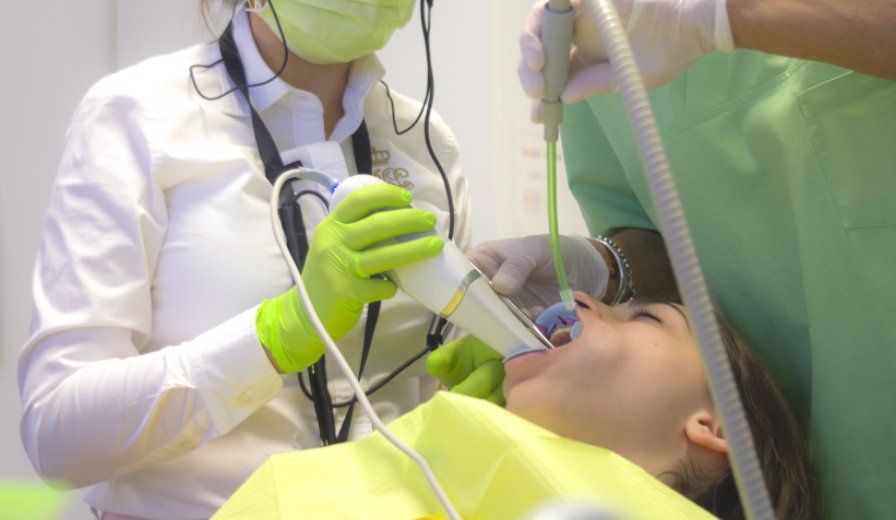
This is the method for those who expect immediate and spectacular results. The treatment takes place entirely in the dental chair under the full control of a dentist. High-concentration gels are used, and their action is often activated by a specialised light (e.g., LED or laser). This guarantees safety—the dentist professionally protects the gums and soft tissues from contact with the preparation.
At-home whitening (under dentist supervision)
This method, often called “tray whitening,” combines the convenience of home use with professional supervision. Based on dental impressions, the dentist prepares custom-fitted, individual trays for your teeth. You receive a set of syringes with a lower, safe concentration gel and apply it yourself at home (usually overnight or for a few hours a day) for a period of **7-14 days**. This is considered the “gold standard” in terms of durability and uniformity of the effect.
Key differences: professional vs. at-home whitening
The choice of method depends on your expectations, lifestyle, and the initial condition of your teeth.
| Feature | Professional In-Office | Supervised At-Home Tray Whitening |
|---|---|---|
| Speed of Effect | Immediate (1 visit, approx. 60-90 min) | Gradual (visible after a few days) |
| Gel Concentration | High (controlled by the dentist) | Low or medium (safe for home use) |
| Safety | Maximum (gum protection, full supervision) | High (perfectly fitted trays) |
| Risk of Sensitivity | Higher, but short-lived | Minimal, spread out over time |
| Durability | High | Very high (considered the most durable) |
Is teeth whitening safe?
This is one of the most common questions we hear. The answer is **yes**, but under key conditions. The safety of the procedure is primarily guaranteed by a **professional qualification** conducted by a dentist. Before we begin whitening, we must be certain that all teeth are healthy—free of decay, leaking fillings, or gum inflammation. Using proven, certified preparations with a neutral pH ensures that the enamel will not be damaged or weakened.
How to care for your teeth after the whitening treatment?
To enjoy the effect for as long as possible, **aftercare is crucial**. Immediately after the treatment, teeth are more susceptible to absorbing pigments. For this reason, for a minimum of **48 hours** (and preferably longer), you must follow a **”white diet,”** avoiding intensely staining foods and drinks such as coffee, tea, red wine, beetroot, or berries. It is equally important to stop smoking and maintain exemplary oral hygiene.
Frequently Asked Questions (FAQ)
| Question | Answer |
|---|---|
| 1. How long does the whitening effect last? | The effect is individual and depends on your diet and hygiene. It usually lasts from 1 to 3 years. It can be easily **”refreshed”** with a short touch-up treatment. |
| 2. Does teeth whitening hurt? | The procedure itself is **painless**. Some patients may experience temporary sensitivity to cold, which usually subsides within 24-48 hours after the treatment. |
| 3. Can I whiten dead teeth, crowns, or veneers? | Standard whitening methods only work on natural tooth tissues. Crowns, veneers, and fillings will not change their colour. Dead teeth (after root canal treatment) require a different, **specialised internal whitening procedure**. |
Do you have more questions or want to assess which whitening method will bring the best results in your case? Trust our experts. Contact us to schedule a safe consultation and let’s plan your new, dazzling smile together.